A First Visit to a County Fair: What to Notice Beyond the Midway
A first visit to a county fair is richer when you know where to look: notice livestock, garden displays, community crafts and traditions beyond the rides.
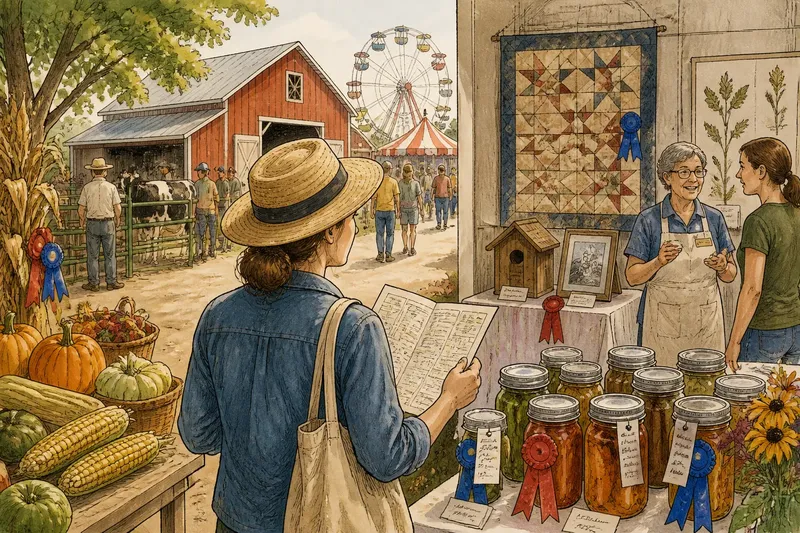
Where should you look first at a county fair if the rides are not the whole point? On a first visit to a county fair, start with the buildings and tables that show what the surrounding community grows, makes and chooses to celebrate. The midway will announce itself. A display of jars, seed heads or neatly folded quilts may need a little more attention.
There is no required route and no need to know the proper name for every animal or preserve. Treat the fair like a town’s open notebook: move at your own pace, notice the details, and let a conversation or a smell change your direction. These field notes are for the parts that reward a slower look.
Start with the fair map, then leave room to wander
At the entrance, scan the map or printed program for livestock barns, the exhibit hall, food stands, demonstrations and scheduled judging. Those labels help you find the fair’s less conspicuous corners. They do not have to dictate the day.
Choose one destination away from the midway before you start walking. If the exhibit hall is across the grounds, go there while you are still fresh; if a livestock judging is about to begin, settle near the ring and watch a class. Then follow whatever catches your eye. A fair is less a museum route than a busy front porch, and the porch has no arrows on the floor.
Check the program for timing. A craft demonstration, livestock class or music set may happen only at a particular hour, while static displays can usually wait. If a schedule is crowded, pick one event and leave the rest as possibilities rather than obligations.
Read the agricultural displays as local information
In a produce or crop display, look past the ribbons to the objects themselves. A row of squash can show differences in shape, skin and intended use; a display of corn, cotton, peanuts or tobacco may point toward crops familiar to that county or region. Labels often identify the grower, variety or category, turning a polished exhibit into a small lesson in local agriculture.
Notice what is absent as well as what is present. The fair’s exhibits reflect what people entered, what the organizers chose to include and what the season made available. They are a view of local interests, not a complete inventory of the region’s farms.
At a livestock barn, give animals space and look for signs posted near pens. You might see poultry, rabbits, sheep, goats, cattle or pigs, depending on the fair. Watch how handlers keep gates closed, move around an animal and prepare for judging. Those ordinary motions can tell you more about care and practice than a quick glance at a ribbon.
Farm machinery and soil displays can be just as revealing. A display may include hand tools, seed, hay, timber or equipment used in local work. Read the captions, and notice which tasks the exhibit makes visible. The fair’s agricultural story is not only about what grows; it is also about the work that gets it to a market, kitchen or barn.
Spend time in the exhibit hall
The exhibit hall is often where county-scale attention becomes most personal. Look for preserves, baked goods, needlework, photography, woodworking, flowers, school projects and handmade decorations. Categories vary, but the variety can show what residents consider worth practicing, teaching or entering.
Read labels before deciding what a display means. A jar may be entered for appearance, a cake for a particular class, and a quilt for technique or pattern. The judging category gives context; without it, a visitor can mistake a careful entry for a simple beauty contest.
Notice the small signs of process: tidy seams on a sewn piece, a handwritten recipe card beside preserves, or a plant’s name printed beneath its pot. These details make the room legible without turning it into a puzzle you have to solve. If a volunteer is nearby and not busy, ask what a category means or how the entries are arranged. A brief question is usually more useful than pretending to know.
Imagine you pause beside a shelf of pickles and see entries labeled by style rather than by a broad “best” category. You could read the labels, ask a volunteer how the classes differ, and then look for that distinction in the neighboring jars. The expected result is simple: the shelf becomes a set of specific choices, not just a row of glass containers.
What should you notice in the community exhibits?
How can you tell what a display is about?
Start with the caption, sponsor name or list of participants, then look for the objects that connect them. A display arranged by a school, library, garden club or local organization may explain a shared project more clearly than its decoration does.
What does a fair’s schedule reveal?
Compare the day’s events with what appears on the grounds: a livestock show, cooking demonstration, local music set or youth exhibit may indicate which traditions organizers make room for. A printed program shows what is planned, while the exhibits show what people have brought.
How should you approach a demonstration?
Stand where you can see without blocking the work, and listen for the terms or materials the demonstrator names. If questions are invited, ask one concrete thing about the process; if the person is busy, let the demonstration proceed without turning it into an interview.
What is a respectful way to photograph the fair?
Photograph signs, displays and grounds when they are open to visitors, but ask before making a person the subject of a close portrait. Follow posted rules around animals and demonstrations, and avoid reaching over barriers for a better angle.
Follow the food toward its local context
Fair food is part of the visit, but it can also lead you back to the agricultural and community displays. Look for a local ingredient named on a menu, a cooking demonstration, or a food stand run by a school or civic group. Not every vendor uses nearby produce, so read signs or ask rather than assuming that a familiar dish has a local source.
Take a moment to notice how the food is served and where people gather to eat. A picnic table beside the livestock barns offers a different view of the grounds than a bench near the rides. The menu may be familiar; the setting, company and timing are what make it part of this particular fair.
When an organization is selling food, its sign can explain who is doing the work and what the proceeds support. That information offers a useful connection between the fair as entertainment and the groups that help keep community events running.
Let local traditions set the pace
County fairs often mix formal judging with informal routines: families returning to the same food stand, neighbors greeting one another near the barns, or an annual parade of decorated animals. You do not need to recognize every tradition to notice how it works. Watch who takes part, where people gather and how the event moves from one activity to the next.
Traditions can be local without being ancient or uniform. A program may include a long-running contest beside a newer exhibit, and both can matter to the people who organize them. Avoid treating one fair as a portrait of the entire South; each county’s choices reflect its own landscape, institutions and participants.
If a custom is unfamiliar, the simplest approach is to ask what is happening and listen to the answer. A fair may include religious, civic, agricultural and family traditions side by side. There is no need to flatten them into a single regional character.
Make a visit manageable without turning it into an assignment
For a relaxed first visit, choose a few things you genuinely want to see: perhaps one barn, one exhibit hall, one scheduled event and a meal. Build in unplanned time between them. A fair can be noisy, warm, crowded or spread across uneven ground, so practical choices matter more than completing a route.
- Check the fair’s hours, map and event schedule before leaving.
- Wear shoes suited to walking on pavement, grass or packed dirt.
- Bring water if permitted, and look for posted rules about bags and food.
- Keep hands away from animals and follow signs at pens and barns.
- Choose a meeting place if your group may split up.
- Leave time to sit, watch and change plans when a display holds your attention.
For access needs, weather concerns, animal contact and photography rules, rely on the fair’s posted guidance and staff; local conditions and policies vary. That is more useful than guessing from last year’s program or from another county’s fair.
As you leave, think of the county fair beyond the midway as a collection of small, observable choices: which crops are displayed, which skills are entered, which groups host a table and which traditions draw people together. You do not have to turn those observations into a grand theory. Remember one detail you had not expected to notice, and let it be a reason to look for the exhibit hall before the rides on your next visit.